

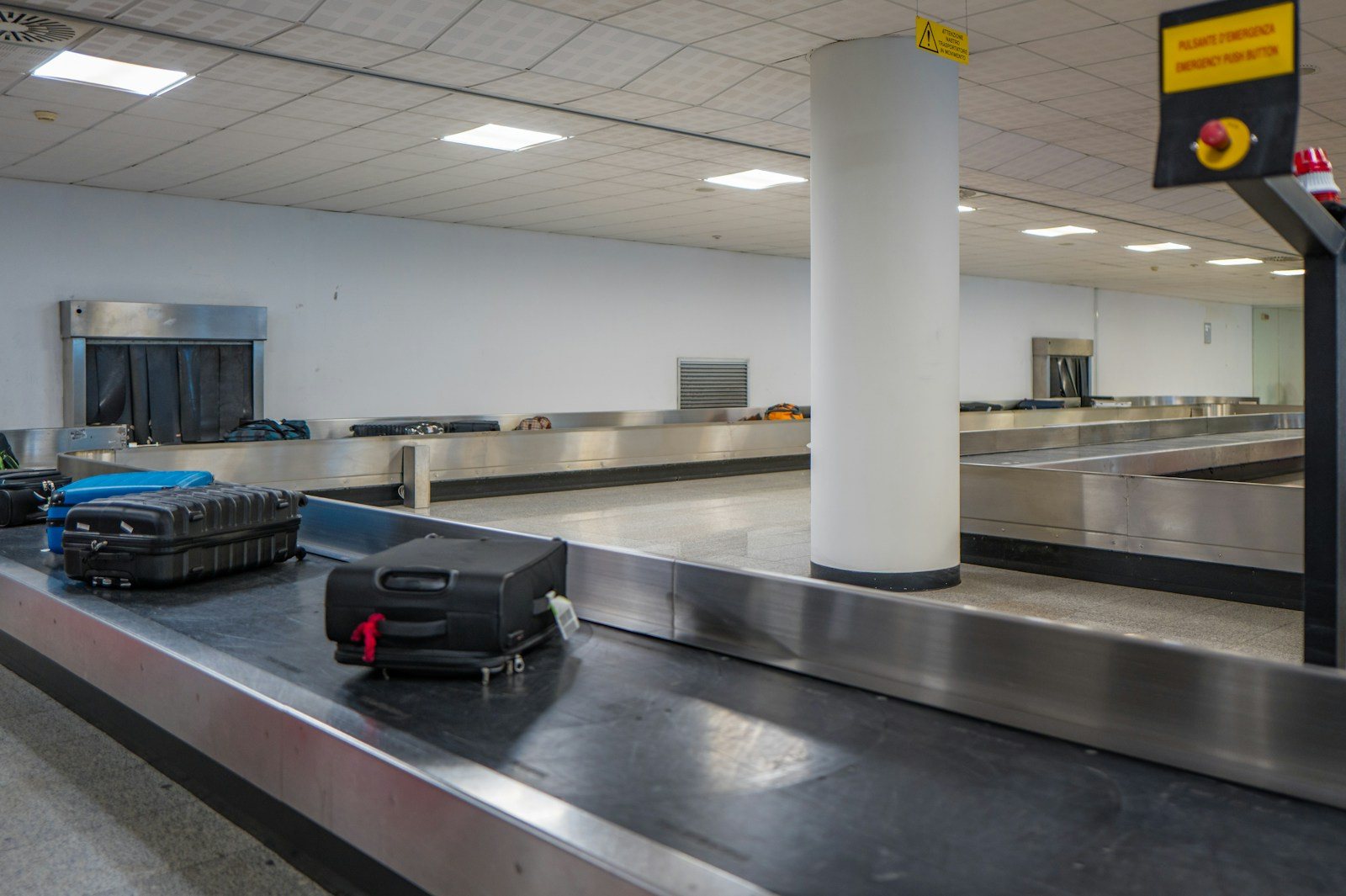
If an airline loses your luggage, report it at the airline’s baggage desk before you leave the arrivals hall and get a Property Irregularity Report (PIR) with a file reference. Then keep receipts for essentials, track the file, and send a written claim on time: within 7 days for damaged or missing items, and within 21 days of getting a delayed bag back. On international flights, a checked bag that still has not arrived 21 days after it should have can be claimed as lost under the Montreal Convention.
A bag that misses the carousel may be delayed by a day or two, damaged, or truly lost. The first steps are the same in every case, but the deadlines and what you can claim are not, so it helps to know which situation you are in.
What should you do first when your bag does not arrive?
Do not leave the baggage hall without reporting it. Once you walk out through customs, it can be hard to get back to the right desk.
- Go to the baggage service desk of the airline that flew your last flight. On a connecting trip this is usually the one to start with, even if a different airline flew the first leg.
- File a Property Irregularity Report. Give your bag tag number (usually on the receipt sticker you were given at bag drop), a description of the bag, and a delivery address. Ask for a copy of the report and write down the file reference.
- Ask what the airline will cover while you wait. Ask about essentials such as toiletries and a change of clothes, whether it pays a daily allowance, and how to send receipts.
- Photograph your documents. Boarding passes, bag tag receipts and the report itself. You will need them for any claim.
- Track the file and follow up. Use the reference to check progress online or by phone, and keep a note of every call, date and name.
The UK Civil Aviation Authority says you must report lost, delayed or damaged luggage at the airport and keep a copy of the report, and that having a PIR is not a guarantee that the airline will accept your claim (UK CAA: lost, delayed or damaged baggage). The report proves you raised the problem; the written claim is what asks for money.
Is your bag delayed, lost or damaged, and what are the deadlines?
For international flights, the Montreal Convention sets the main rules. It requires complaints about checked baggage to be made in writing, and if no complaint is made within the time limits, you can lose the right to claim (Montreal Convention text, Articles 17, 31 and 35, legislation.gov.uk).
| Situation | When it applies | Written claim deadline | What you can usually claim |
|---|---|---|---|
| Delayed bag | The bag arrives later than you did | Within 21 days of the bag being delivered to you | Reasonable costs of essentials while you wait, with receipts |
| Lost bag | The airline admits it is lost, or it has not arrived 21 days after it should have | Do not wait for day 21: the UK CAA advises writing within 7 days for lost items | The proven value of the bag and contents, up to the legal limit |
| Damaged bag | The bag arrives broken or soaked | Report at the airport, then in writing within 7 days of receiving it | Repair, or replacement value if it cannot be repaired |
| Items missing from a bag | The bag arrives but something inside is gone | Within 7 days (the CAA groups lost or stolen items with damage) | The proven value of the missing items |
The EU’s Your Europe portal gives the same deadlines: write to the airline within 7 days for lost or damaged luggage, or within 21 days of receiving it if it was delayed, and notes there is no standard EU-wide claim form (Your Europe: air passenger rights).
A good rule: send something in writing within 7 days no matter what, then add to it later. A short email that gives the file reference and says the bag is missing protects you while the search goes on.
There is also an outer limit. Under Article 35 of the Convention, the right to damages ends if you do not bring a court action within two years of arrival. Most claims never get near that, but it matters if the airline stops replying.
What can you claim while your bag is delayed?
The CAA says most airlines reimburse the bare essentials you need to buy while your bag is delayed, such as toiletries, underwear and laundry costs, and that some airlines pay a fixed daily rate instead. It also warns that if the bag is delayed on your way home, the airline may decide your losses were smaller because you had your things at home.
Practical points that help a delayed-bag claim:
- Buy what you need, not a new wardrobe. Airlines look for reasonable, necessary purchases.
- Keep every receipt and match each purchase to the days you were without your bag.
- Ask before you spend big. If you need something costly, such as replacement gear for a work event, get the airline’s agreement in writing first.
- Do not expect knock-on costs to be paid automatically. The CAA says airlines do not routinely cover consequential losses, such as missing the start of a cruise, unless a court orders it.
How much compensation can you get for lost luggage?
There is no fixed payout. You are paid for what you can prove you lost, up to a cap. Under the Montreal Convention, the cap for destruction, loss, damage or delay of baggage is set in Special Drawing Rights (SDRs), a unit defined by the IMF. ICAO’s revised limits, effective 28 December 2024, set it at 1,519 SDRs per passenger (ICAO: Montreal Convention 1999 administrative package).
The cash value of that limit moves with exchange rates, which is why consumer guides quote rounded figures in euros or pounds. Treat any local-currency number as approximate and check the current SDR rate if you need a precise figure.
Three things shape what you actually receive:
- Proof of value. The CAA says you will need to show what your bag and its contents were worth, using receipts, card statements or other proof.
- Depreciation. Airlines do not pay “new for old.” An older jacket is valued at what it was worth when lost, not what a new one costs.
- The cap. If you carry more value than the limit, the extra is not covered by the airline unless you arranged a higher limit in advance.
Both the Convention and the EU allow for that higher limit: you can make a special declaration of value when you check the bag, and the airline may charge a fee for it. It must be done at the latest at check-in. For expensive items, travel insurance or keeping them in your cabin bag is usually the simpler route.
One limit to keep in mind: the Montreal Convention covers international carriage between countries that are party to it. Purely domestic flights can fall under national rules instead, so check the airline’s conditions of carriage and your country’s aviation regulator for those.
Which airline do you claim from on a connecting trip?
The CAA notes that bags are most often lost or delayed when you transfer between planes or between airlines. Where you claim depends on how you booked.
| How you booked | Who to claim from | What to watch |
|---|---|---|
| One ticket, one airline | That airline | Straightforward; use its baggage claim process |
| One ticket, several airlines | The first or last airline, or the one that flew the leg where the problem happened | The CAA says the final airline usually handles the claim, so start there |
| Separate tickets (self-transfer) | Each ticket is a separate contract, so start with the airline you checked the bag in with for the flight it went missing on | You rechecked the bag yourself, so keep tag receipts from each check-in |
The one-ticket rule comes from Article 36 of the Convention, which lets you act against the first carrier, the last carrier, or the carrier that performed the leg where the loss happened. On self-transfer flights you should not assume that protection stretches across separate bookings, which is one more reason to keep each bag receipt.
Tight connections raise the chance that you make the flight but your bag does not. If you are choosing between itineraries, our guide on how long a layover should be explains how much buffer to leave for checked bags.
How do you write a lost luggage claim that gets paid?
Send the claim through the airline’s official baggage claim form or email, and keep a copy. Include:
- your PIR file reference and bag tag number
- flight numbers, dates and booking reference
- a list of every item with its approximate age and value
- receipts, card statements or photos that show value
- receipts for essentials bought while you waited
- how you want to be paid
A claim that is easy to check is easier to approve. If the airline rejects the claim or stops replying, ask for its final response in writing, then use the escalation route it names, such as an alternative dispute resolution scheme or the national aviation regulator where one handles complaints. The two-year court limit is the backstop.
How can you lower the risk before you fly?
- Label inside and out. The CAA suggests putting your name, address and email inside the bag in case outside tags come off.
- Photograph the bag and what you packed. It speeds up the report and gives you evidence of contents.
- Keep essentials in your cabin bag: medicines, a change of clothes, chargers, documents and anything valuable.
- Remove old bag tags so scanners read only the current one.
- Allow sensible connection times and avoid the tightest transfers when you have checked bags.
- Price the bag into the fare comparison. A checked bag changes the real cost of a ticket, a point covered in our budget airline vs full-service guide and our list of flight booking mistakes that cost travelers more.
Compare flights with your bags in mind
Search your route and compare total journey time, connection length and what each fare includes for checked bags. A slightly longer layover on one ticket can be worth more than a cheaper itinerary that leaves your bag a tight transfer.
Quick answers
Should I claim from my travel insurance or the airline?
Often both, in order. The CAA suggests travel insurance may cover more of the true cost than the airline pays, but policies usually have an excess and their own claim time limits. Report to the airline first and keep its PIR and written response, since an insurer may ask for them.
What if my cabin bag is damaged?
Different rule. Your Europe says the airline is liable for damaged hand luggage only if it was responsible for the damage. For checked bags, the airline is liable unless the damage came from a defect in the bag itself.
What if I missed my flight but my bag was already checked?
Tell airline staff straight away so the bag can be pulled or traced. Our guide on what happens if you miss your flight covers rebooking and what to do next.
The bottom line
When an airline loses your luggage, speed and paperwork decide the outcome. Report it before you leave the airport, keep every receipt, and put your claim in writing within 7 days, or within 21 days of getting a delayed bag back. On international trips, the Montreal Convention makes the airline liable up to 1,519 SDRs per passenger, but you only receive what you can prove, so the evidence you gather in the first hour matters most.